

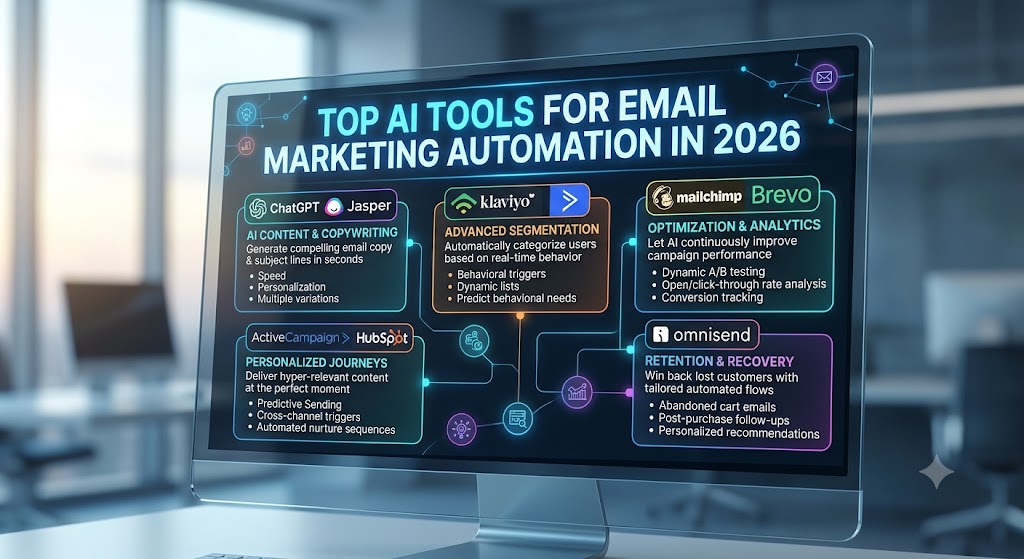
Best AI Tools for Email Marketing Automation in 2026
Email marketing remains one of the highest-ROI marketing channels in 2026. The difference today is that AI can handle everything from writing emails and segmenting audiences to automating entire customer journeys.
If you’re a marketer, agency owner, or small business owner, these are the AI email marketing tools worth considering this year.
Why AI Matters in Email Marketing
Modern AI tools help you:
- Write emails faster
- Personalize content at scale
- Automate follow-ups
- Improve open and click rates
- Recover abandoned carts
- Generate sales on autopilot
The best tools combine automation with AI-powered content generation and analytics.
1. ChatGPT
Best For:
Email copywriting, subject lines, sequences, and campaign planning.
Pros:
- Creates emails in seconds
- Generates multiple subject line variations
- Excellent for welcome and nurture sequences
- Helps brainstorm campaign ideas
Cons:
- Requires integration with email platforms
- Results depend on prompt quality
Example Use Case:
Prompt ChatGPT:
“Write a 5-email welcome sequence for a furniture store targeting new subscribers.”
Within minutes, you’ll have a complete email series ready for editing.
2. Klaviyo
Best For:
E-commerce brands and online stores.
Pros:
- Powerful automation workflows
- AI-generated subject lines
- Advanced customer segmentation
- Excellent Shopify integration
Cons:
- Can become expensive as your list grows
Ideal For:
Brands looking to automate abandoned cart emails, post-purchase sequences, and customer retention campaigns.
3. Mailchimp
Best For:
Small businesses and beginners.
Pros:
- Easy to use
- AI-assisted content creation
- Built-in automation templates
- Good reporting tools
Cons:
- Limited advanced automation compared to competitors
Ideal For:
Businesses launching their first email marketing campaigns.
4. ActiveCampaign
Best For:
Advanced marketing automation.
Pros:
- Powerful automation builder
- Predictive sending
- AI content generation
- CRM integration
Cons:
- Learning curve for beginners
Ideal For:
Businesses that want sophisticated customer journeys and behavioral automation.
5. Brevo
Best For:
Budget-conscious marketers.
Pros:
- Affordable pricing
- Email and SMS automation
- AI writing assistant
- Good deliverability
Cons:
- Fewer advanced features than enterprise platforms
Ideal For:
Startups and growing businesses.
6. HubSpot
Best For:
Companies needing an all-in-one marketing solution.
Pros:
- AI content generation
- CRM integration
- Advanced workflows
- Detailed analytics
Cons:
- Higher pricing
Ideal For:
B2B businesses and agencies managing large customer databases.
7. GetResponse
Best For:
Lead generation and sales funnels.
Pros:
- AI email generator
- Landing page builder
- Webinar integrations
- Conversion funnels
Cons:
- Interface can feel overwhelming initially
Ideal For:
Businesses focused on lead generation campaigns.
8. Omnisend
Best For:
Online stores.
Pros:
- Email + SMS automation
- Product recommendations powered by AI
- Easy automation setup
- Strong Shopify support
Cons:
- Primarily focused on e-commerce
Ideal For:
Brands selling physical products online.
Best AI Email Marketing Stack in 2026
For most businesses, a simple stack works best:
| Purpose | Recommended Tool |
|---|---|
| Email Writing | ChatGPT |
| Automation | ActiveCampaign |
| E-commerce | Klaviyo |
| Beginner Setup | Mailchimp |
| Budget Option | Brevo |
| Enterprise Marketing | HubSpot |
Final Verdict
If you’re starting today:
- Use ChatGPT for creating email copy and campaigns.
- Use Klaviyo if you run an e-commerce business.
- Use ActiveCampaign for advanced automation.
- Use Mailchimp or Brevo if you’re on a budget.
The biggest advantage of AI in 2026 isn’t writing better emails—it’s building automated systems that send the right message to the right person at the right time.
When combined correctly, these tools can dramatically increase engagement, conversions, and customer retention while reducing manual work.