

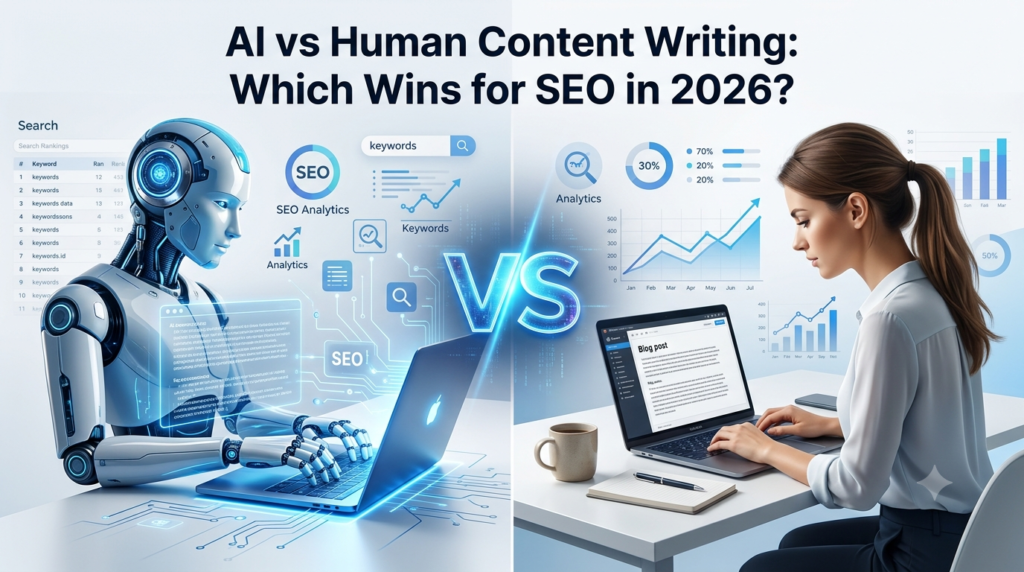
Artificial intelligence has transformed content marketing. With AI writing tools capable of generating blog posts, product descriptions, emails, and social media content in minutes, many businesses are asking the same question:
Can AI replace human writers for SEO?
The short answer is no, but the best results come from combining AI with human expertise. In this article, we’ll compare AI-generated content with human-written content and explain which approach works best for SEO in 2026.
How AI Content Has Evolved
AI writing tools have become much more advanced. They can:
- Generate complete blog posts
- Create SEO-friendly outlines
- Suggest keywords and headings
- Rewrite and improve existing content
- Produce content in multiple languages
This has made content production faster and more affordable than ever before.
AI Content: Pros and Cons
Pros
1. Faster Content Creation
AI can produce a 2,000-word article in minutes, making it ideal for businesses that publish content regularly.
2. Lower Costs
Hiring professional writers for every article can be expensive. AI reduces production costs while increasing output.
3. SEO Assistance
AI tools help optimize content by suggesting keywords, meta descriptions, FAQs, and title ideas.
4. Consistent Tone
Businesses can maintain a consistent writing style across hundreds of articles.
Cons
- Can sound generic
- May include factual errors
- Lacks personal experience
- Doesn’t fully understand brand voice
- Requires editing before publishing
Human Content: Pros and Cons
Pros
1. Original Insights
Human writers bring experience, opinions, and expertise that AI cannot replicate.
2. Better Storytelling
Engaging stories, emotional connections, and persuasive writing still require a human touch.
3. Higher Trust
Readers often trust content that demonstrates real-world knowledge and practical experience.
4. Stronger Brand Voice
Experienced writers can capture a brand’s personality and communicate it consistently.
Cons
- Higher cost
- Slower production
- Difficult to scale quickly
Which Performs Better for SEO?
Search engines don’t reward content simply because it was written by a human or AI. They reward content that is:
- Helpful
- Accurate
- Well-structured
- Relevant to search intent
- Trustworthy
- Updated regularly
Poor-quality AI content is unlikely to rank well, but high-quality AI-assisted content that has been reviewed and improved by a human can perform just as well as fully human-written content.
The Best Strategy in 2026: AI + Human Editing
Instead of choosing one over the other, successful marketers use AI to speed up content creation and humans to refine it.
A typical workflow looks like this:
- Research keywords
- Use AI to generate an outline
- Create the first draft with AI
- Add personal insights and examples
- Fact-check the content
- Improve readability
- Optimize for SEO
- Publish and update regularly
This approach combines the speed of AI with the creativity and expertise of human writers.
When Should You Use AI?
AI is ideal for:
- First drafts
- Product descriptions
- Email marketing
- Social media captions
- Blog outlines
- Meta titles and descriptions
- FAQ sections
When Should Humans Take Over?
Human writers should handle:
- Thought leadership articles
- Case studies
- Industry analysis
- Personal stories
- Brand messaging
- High-converting sales pages
These types of content benefit from originality, experience, and emotional connection.
Final Verdict
The debate isn’t really AI versus humans anymore—it’s about using both effectively.
AI is an incredible productivity tool that helps marketers create content faster, but it still needs human oversight to ensure accuracy, originality, and value. Businesses that combine AI efficiency with human creativity are likely to achieve the best SEO results in 2026 and beyond.
If your goal is to publish high-quality, search-optimized content consistently, let AI handle the repetitive work while humans focus on strategy, expertise, and storytelling. That’s the winning formula for modern content marketing.